

Why Women Gain Weight Differently During Menopause
Do you know that feeling? You’re not really doing much differently than before, but your weight is shifting anyway. Especially around your stomach. Your clothes are tighter, you feel bloated, and the scale is slowly moving up. Welcome to a phenomenon almost every woman in menopause recognizes: visceral fat.
Visceral fat is different from the fat you see and feel under your skin. It’s deeper, around your organs, and behaves hormonally differently from other fat storage. During menopause, this type of fat increases, even if your weight hardly changes. This has everything to do with your hormones.
The role of estrogen and progesterone
Before menopause, estrogen partly ensures that fat is stored around the hips and thighs. As estrogen production declines, as in perimenopause and menopause, that storage shifts to the abdomen. Your body literally reacts differently to calories and storage.
In addition, progesterone decreases, insulin sensitivity diminishes, and cortisol (stress hormone) is more often elevated in menopausal women. All of this combined creates a perfect storm for belly fat storage. Not your fault. But something you can actively do something about.
Why 'just eat less' doesn't work
Many women try to eat during menopause as they always did, or even eat less. But with declining estrogen, metabolism also declines. Your body has more difficulty maintaining muscle mass, and muscle mass is precisely the engine of your metabolism.
Those who eat less without extra protein and training lose muscle instead of fat. The scale might go down a bit, but the percentage of body fat increases. You become 'thinner but heavier' in composition, and that visceral fat doesn't disappear.
What does work: more protein, fewer spikes
Research consistently shows that menopausal women benefit from a higher protein intake. Proteins are the building blocks of your muscles, and sufficient protein helps maintain muscle mass while improving your body composition.
The Killerbody Mealshakes are a practical way to get enough protein daily, even on days when you don't have much appetite. With a complete amino acid profile, one shake provides everything your muscles need — compact, easily digestible, and quick to prepare. Ideal if you notice during menopause that your appetite is fluctuating but your nutritional needs remain constant.
Strength training: the key to less visceral fat
There is one intervention that consistently reduces visceral fat in menopausal women in studies: strength training. Not just cardio, but resistance training. Muscles burn calories even at rest, improve insulin sensitivity, and directly counteract the hormonal shifts of menopause.
Even two to three sessions per week of 30-45 minutes make a measurable difference. You don't have to lift heavy to start – your own body weight, resistance bands, or light weights are already sufficient.
The 4-week Back in Shape plan: especially for menopausal women
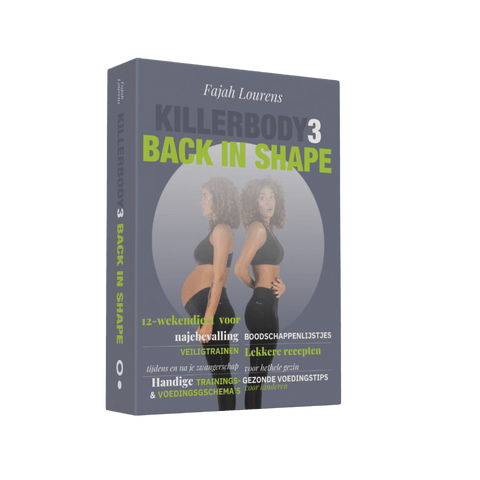
Do you want a concrete approach that takes into account your hormones, your body, and your life stage? The Back in Shape program by Killerbody is designed for women experiencing menopause. It combines nutrition, exercise, and lifestyle in a way that works for a changing body.
No crash diet. No extreme training schedules. But a progressive plan that matches where you are now, and guides you step by step towards more energy, less belly fat, and a stronger body.
The 8-Week Killerbody Challenge: structure that delivers results
Do you need more structure? The 8-Week Killerbody Challenge offers a complete training program that can be done at home or in the gym. Perfect to combine with the Back in Shape nutrition plan. Weekly progression, clear exercises, and a community of women with the same goal.
Visceral fat doesn't disappear overnight. But with the right approach – more protein, strength training, and a plan that suits you – something really changes after 8 weeks.
Summary: what you can do now
Visceral fat in menopause is a hormonal phenomenon, not a sign of failure. It requires a different approach than you're used to. More protein (such as via Killerbody Mealshakes), resistance training, and a program tailored to you – that's the combination that works. Start small, be consistent, and give your body time to respond.